
Without an address you do not exist
No health insurance, no benefits, no post. Anyone who is registered nowhere falls outside the very system meant to help them. On regional ties, the postal address, and a hotel room as a residential address.
The system puts the brakes on recovery
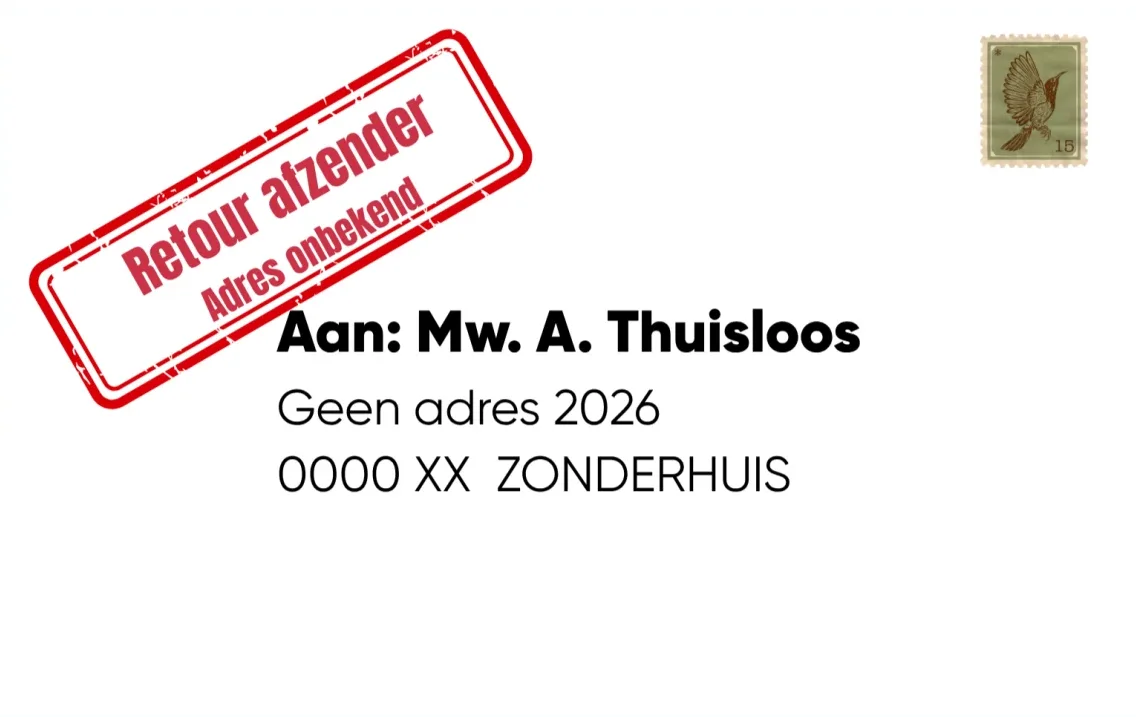
Without an address you are not only on the street, you are also outside the system that is supposed to help you. There is something many people do not know. Or better put: something we would rather not see. Without an address, you effectively do not exist in the Netherlands.
You cannot take out health insurance. You cannot apply for benefits. You receive no post. Even working becomes complicated when you are registered nowhere. You do exist, but not in the system. And without the system, no access.
“You have to be registered somewhere”
It sounds logical. But what if there is nowhere you can be? Some people sleep on sofas at friends or family. Others rent a room temporarily, without a contract. Others move on constantly and never stay anywhere long enough to “exist” on paper. Where do you register then? And more importantly: who still sees you, when you are registered nowhere?
The reality behind the rules
Recently, through Room for Change, we helped a mother with two children. She works. A permanent job in education in Amsterdam. Her children go to school there. Everything we expect of someone, she does. And still she became homeless after her relationship ended. She found temporary shelter wherever she could. From address to address, sublet rooms. She is registered with family, outside Amsterdam. And that is where it goes wrong. She gets no help. No access to shelter or support. At least, not in Amsterdam...
Why? No regional ties.
To get help, you often have to prove years of connection to a city. In this case: four years. But how do you prove stability when stability is exactly what you have lost?
Too self-reliant, and therefore out of sight
What makes this case even more bitter: even when you do ask for help, that does not mean you are helped. Because the system looks elsewhere. At rules, at registrations, at assumptions. Not at reality. And so this happens: someone who works, cares for her children and actively seeks help still falls through the cracks. Too self-reliant. Not “urgent enough”. Not registered in the right place. And meanwhile without a home.
There is a solution, but we do not use it
What many people do not know: municipalities are obliged to provide a postal address to people without a fixed home address. That postal address is crucial. It is often the first step towards recovery. You can register. You receive post. You can take out health insurance. You can apply for benefits. You can rebuild your life. But in practice we see something else. Municipalities hold off. Procedures are unclear or strict. People are sent from pillar to post. And so they stay stuck in an impossible situation: without an address, without access, without progress.
From residential address to postal address
At Room for Change we do something simple, but with real impact. A hotel room is not only a bed. It is a residential address. And with that, something fundamental becomes possible. From that address someone can apply for a postal address. And that opens the door to everything that was impossible before. Work. Registration. Insurance. Income. Stability. An address is not a detail. It is the key.
What I keep wondering: why do we make an address a condition instead of a starting point? Why does someone have to satisfy the system before they are allowed to begin recovering? And how many people disappear between the cracks, simply because they do not exist administratively? In my view, access to an address, whether residential or postal, should be the basis. Not the exception.
We should be more flexible about registration and residence. Less rigid about regional ties. Municipalities should take their responsibility and stop turning away people who are entitled to a postal address. And perhaps most important of all: systems should follow people. Not the other way around.
What you can do differently tomorrow
Homelessness is not a choice, it is the consequence of a series of (often sad and painful) events. See the person in front of you. Offer a smile. Give something if you can spare it. But more is needed. Much more. We are looking to work with people and organisations willing to look beyond rules and risks: policymakers, property managers, housing associations, hotel management, anyone with nerve and their heart in the right place. Together we can open the doors that stay closed today. Together we can offer individuals and families a safe place after all.
Would you like to contribute or think along with us? Or do you want to make a difference right away?